Smart obstacle
One LED roll, MONO/QUAD local audio and own PSU; separate LED floor.
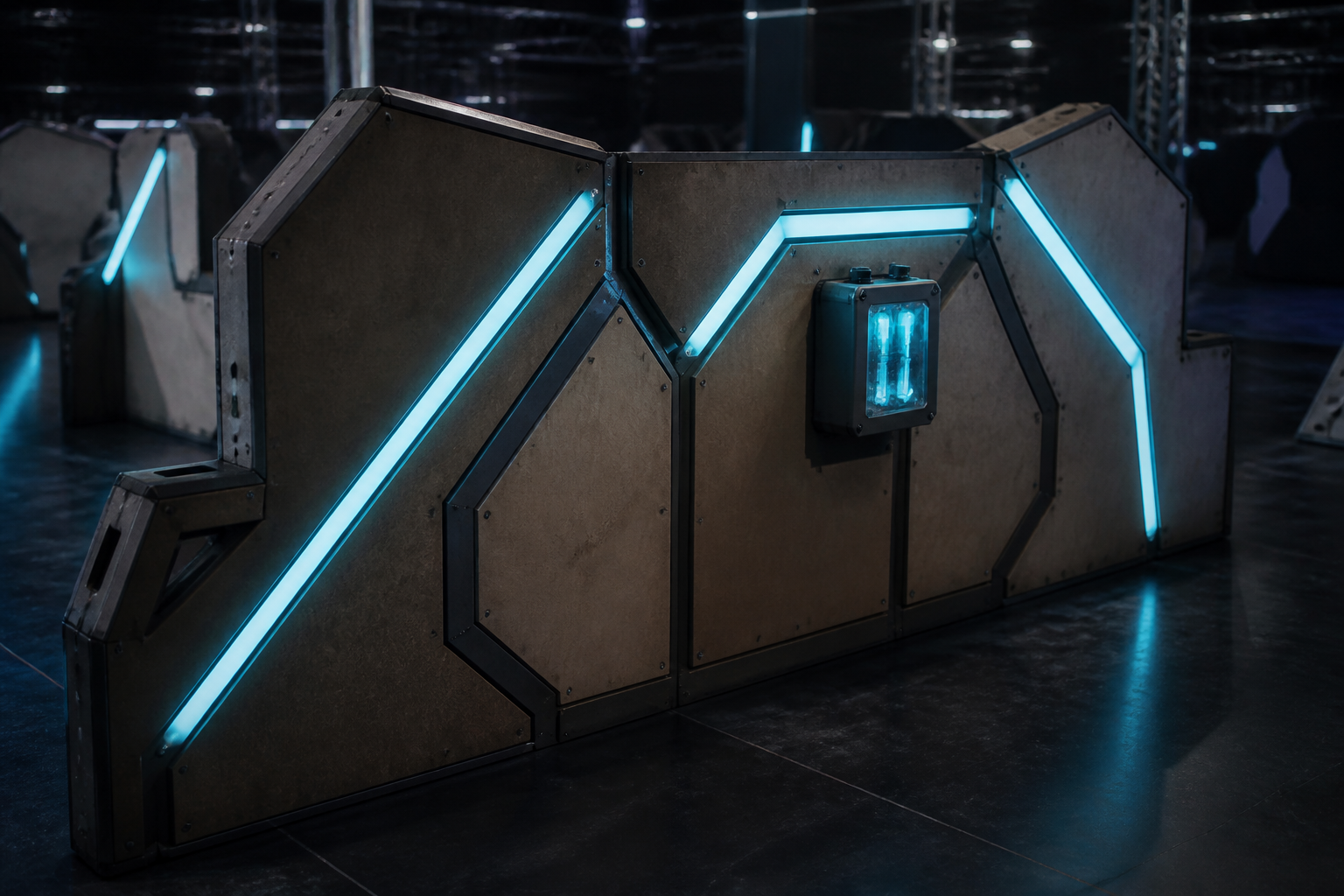
Engineering
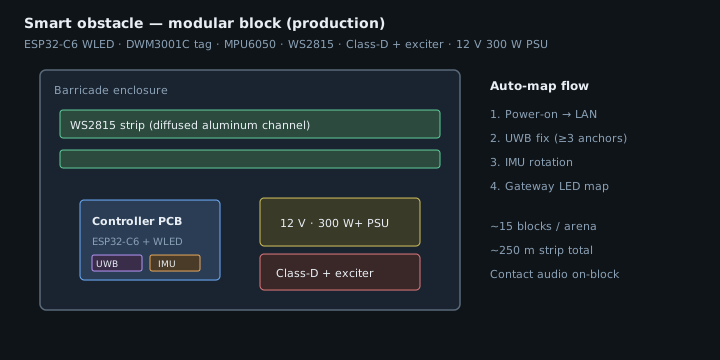
Smart obstacle — local LED and audio v3 bench design
Reviewed 2026-11-11. One obstacle has its own ESP32-C6, 12 V / 10 A supply and one 5m WS2815 roll (30 LED/m, 150 pixels). The LED floor is a separate device with its own controller and supply. MONO and QUAD are alternative audio designs for one obstacle.
Current v3 architecture
| Part | Current design |
|---|---|
| Control and LEDs | ESP32-C6 → AHCT125 → one WS2815 roll; GPIO2 |
| Power | 12 V / 10 A → protected distribution; AP63300 5 V logic; floor excluded |
| MONO | DFRobot DFR0299 with 4V regulation → one PAM8610 → one Visaton FR10HM 8 Ω |
| QUAD | Teensy 4.1 → two PJRC Audio Adapter Rev D2 → four PAM8610 → four FR10HM |
| TCA9548A in QUAD | Selects I²C control of two adapters at address 0x0A; audio uses I²S with common clocks |
| Protection revision | Provisional F1 10 A / F3 5 A; F4–F6 and extra LED ports unpopulated/disconnected |
FR10HM is a loudspeaker. Tactile exciters are a separate future experiment. Current drawings are wired prototypes, not released PCBs or proof of physical acceptance. The concept/engineering illustration is historical; use the current device reference for wiring status.
Implemented firmware
smart_block_sw 0.1.0: one 150-pixel output, brightness cap 102/255,
DFPlayer at UART1 9600 bit/s, TX18/RX19/BUSY20, checksum off by default.
Gateway broadcasts fx and verdict over WebSocket /smart_block.
V3 wiring uses TX19/RX18; adapt the firmware profile and verify the original DFRobot checksum format. QUAD Teensy playback, four gains and shared-time starts are not implemented.
Addressing and validation
Firmware announces hello/device_id, while the gateway registers register/deviceId.
Broadcast does not prove targeted addressing. No obstacle UWB/IMU auto-mapping is initialized by this firmware.
Assembly, real current, thermal/fault behavior and LED/audio timing require bench acceptance. Current FX contract and gaps.
Independent floor and future venue
The first floor target is its own ESP32-C6 and four 5m rolls, 600 pixels, driven by gateway spell/events without footstep sensing. Its dedicated firmware, gateway RGB renderer and Admin planner are implemented; physical power, timing and commissioning remain unvalidated. The separate newer BTF 5V / 4×50 sample needs matching firmware and mapping.
The older ~15-obstacle / ~250m WLED, UWB/IMU auto-map and 300W-per-block architecture is a future venue scenario. It is not the current prototype BOM. At 30 LED/m, 250m is 7,500 pixels; the old 15,000 figure assumed 60 LED/m. Venue plan and dated budget.